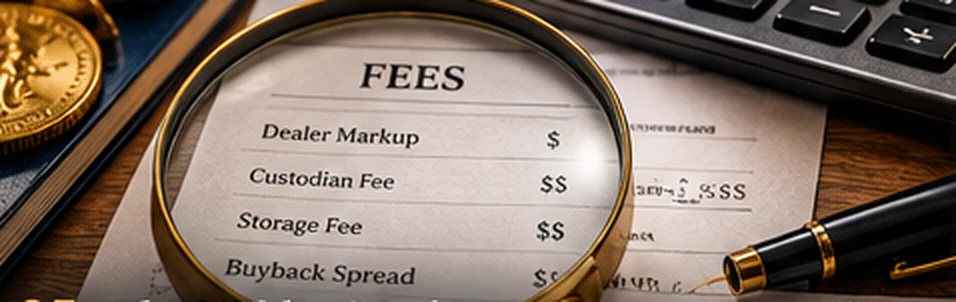
A salesperson says you can “move your $50,000 retirement savings into gold.” That statement sounds like a clean conversion: fifty thousand dollars before, fifty thousand dollars after. But a physical-metal order has two prices—the price you pay and the price someone will pay you for it—and recurring charges continue after the purchase.
This is a deliberately hypothetical reconstruction of a costly IRA offer. It does not describe a named dealer, a real transaction or a market forecast.
Model: $50,000 allocated to the purchase
Assume you have $50,000 to allocate, the dealer charges 8% above the spot-value benchmark, the eventual dealer buyback price is 2% below the benchmark, annual custody is $150, annual storage $115, and you hold for five years. Assume zero account setup and exit fees, and assume the metal's spot price does not move.
| Component | Modeled value |
|---|---|
| Initial IRA funds allocated | $50,000 |
| Approximate underlying fine-metal spot value purchased | $46,296 |
| Initial dealer premium embedded in purchase | $3,704 |
| Five years of custody and storage | $1,325 |
| Sale discount if spot is flat (2% of metal benchmark) | $926 |
| Total modeled economic cost | $5,955 |
The amounts are rounded to the nearest dollar. The exact calculator uses unrounded intermediates. The example excludes taxes, market movements, opportunity cost, insurance outside the stated fee, and any other possible provider charges. A particular dealer might charge much more or less.
Why the math is easy to misunderstand
A common mistake is to take 8% of $50,000 and assume that's the dealer's premium. But the assumption here is a price 8% above spot: $50,000 ÷ 1.08 ≈ $46,296 of benchmark metal value. The premium embedded in the $50,000 paid is about $3,704. It's a slightly different calculation from an 8% deduction taken directly from the deposit.
The buyback discount creates another cost: the dealer offers less than the underlying metal benchmark at sale. Even after five years of a flat gold spot price, the difference is economically real. The annual account and storage charges further reduce the position's net outcome.
A revealing question: how much must gold rise just to break even?
Under this example and assuming the stated annual charges are an additional total economic outlay, the site's model estimates that gold's benchmark price would need to increase about 13.1% over five years to cover the modeled costs. That's an annualized equivalent of approximately 2.5%, but it is a hurdle rate, not a guaranteed return or investment forecast.
If the gold price declined, the result would be worse. If the deal contained additional shipping, insurance, transaction or closing charges, the hurdle would rise. If recurring fees were deducted from the IRA's invested balance instead of paid separately, the scenario needs a different cash-flow model.
The sensitivity experiment worth doing
Keep the deposit and five-year holding period fixed, then change only the purchase premium from 8% to 3%. Change the buyback discount from 2% to 1%. Compare the new break-even value. A lower premium may matter more than a small introductory discount on account setup.
Now change the holding period to one year. The one-time purchase and sale spread is concentrated over a much shorter investment horizon. Then change it to ten years: recurring fees become more important. No single “gold IRA fee percentage” captures every scenario accurately.
What a real written quote should include
Request metal product name, weight, purity, the timestamped spot benchmark, the full retail amount, the dealer's same-day repurchase bid, and every custody, storage, shipping and exit charge. If a fee is unknown, leave it unknown in our analyzer. Do not replace silence with a free service.
Use the Quote Analyzer for actual proposal inputs or the homepage estimator to vary hypothetical assumptions. Our dealer quote request is designed to make competing offers comparable.
The correct takeaway
A metal investment can gain value over time, but starting with a high purchase premium creates an immediate hurdle. An eligible IRA rollover by itself does not create an investment return. A buyer deserves to know the starting line—not just see a picture of an impressive gold bar.
Primary sources and review notes
Reviewed October 30, 2026. Verify current rules and account documents before acting. Fee and performance examples are hypothetical. IRA Gold is not a tax, legal or investment adviser.